“So it is okay for working adults to be like that too. That is a bit of a relief.”
A student once said that to me while we were talking about how we spend our days off. On my days off, I sometimes spend half the day dozing in bed or play games until late at night. I do not go out somewhere every week, nor do I use all my free time for a side job or studying for qualifications. When I tell students this, several of them have seemed relieved to hear that adults with jobs have days off like that too.
When I look at the people around me, I see some who spend their days off working a side job. Some work their regular job during the day and a side job at night, while others use their days off to attend conferences or prepare presentations. I also see friends going on trips together.
When I see them, I end up comparing their days off with mine. It feels as though I am the only one doing nothing and wasting my time.
Looking for Results Even on My Days Off
How I feel after spending half the day asleep or playing games varies from one day to the next.
On a day when there was something I wanted to do but never started, it does not feel like I “did nothing.” It feels like I “could not do anything.” There are also days when I see other people studying, working side jobs, or traveling and feel down because I have nothing to show for mine.
On the other hand, if I am tired from work during the week, sleeping for half the day gives my body a chance to rest. Sometimes playing games helps me reset, and I am glad that I had a leisurely day.
Even when two days off look much the same, my judgment of myself changes depending on what I had wanted to do, how tired I was, and whether I compared myself with someone else. That is why I cannot always tell myself that a day spent doing nothing was a good thing. If there was something I genuinely wanted to do, I think it is only natural to regret not doing it.
Days off that include something worth telling other people about, such as a side job, studying, or a trip, are easy to notice. By contrast, people have fewer reasons to mention that they slept for half the day or stayed home playing games. If I look only at the ways people visibly spend their time, it can seem as though everyone but me is always doing something on their days off.
Still, I should not have to grade each day by asking what I accomplished whenever I look back on it. I do not need to connect resting to my productivity at work or explain playing a game as some kind of learning experience. Even time that seems to have left nothing behind does not need to be justified by a result.
Something I Used to Think Was Not Worth Making
Recently, I made a color code guessing game, rather than just a color guessing game. The game shows a color on the screen and asks you to guess its color code. I built it with HTML, CSS, and JavaScript by explaining what I wanted to Codex as I went.
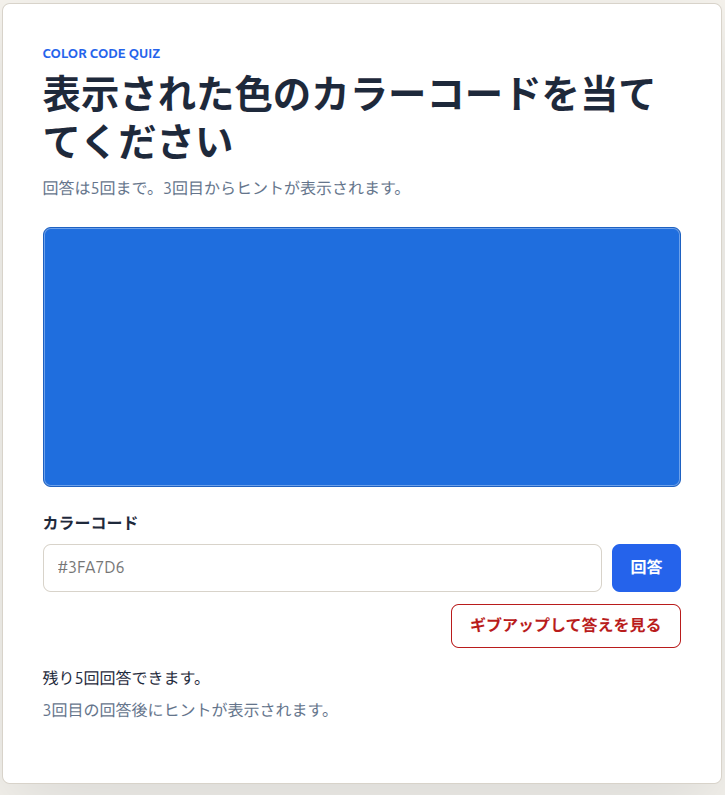
The color code guessing game
It is not something I need in my life, nor did it solve a problem I had wanted to address for a long time. The idea simply seemed a little interesting when it occurred to me.
In the past, I think it would have remained nothing more than an idea. It was not clear enough for me to implement entirely from what I already had in my head. Given the effort of looking up how to make it and trying each part one by one, I probably would have decided, “It sounds interesting, but it is not worth going out of my way to make.”
But AI tools, including Codex, have lowered the barrier to turning an idea into something that works. Even without a complete specification from the start, I can describe a vague intention and decide what to do next as I look at something that already works. Instead of having to think everything through before I start making something, I can now think as I make it.
When it was finished, I thought, “I made something interesting.” The feeling may have been fleeting, but watching a vague idea take shape was both fun and satisfying.
That led me to think I could also make a game that displays the color bands used on electrical resistors and asks you to guess their values. It might even become a way to learn something through play.
I did not make the game for learning in the first place. I only thought of another use after I had made it. I did not begin making it because it already had meaning; putting it into a tangible form allowed something like meaning to emerge afterward.
Does Making Something Need a Purpose?
AI can be used to make work more efficient. I use it myself to automate tasks that I find a little inconvenient. That kind of use has a clear purpose: saving time.
The color code guessing game, on the other hand, did not have such a clear purpose. I had no reason to keep working on it, no plans for anyone else to use it, and no expectation that it would be useful in the future. Even so, it was fun to follow the idea and spend time giving it form.
I could describe this experience as learning or personal growth through AI. It is true that I might learn something while making it or find that it leads to another idea. But if I make that the purpose from the beginning, I end up demanding results even from my hobbies and play.
Meaning can emerge later. It is also fine to try something once, leave it there, and have it lead nowhere. If I try something because it sounds interesting and enjoy it, that should be enough, even if it ends there.
Not Grading My Days Off Only by Their Results
There is nothing wrong with spending time on a side job, studying, or attending a conference. Days off spent pursuing something I want to do and achieving growth or results matter too.
But that is not the only way to spend a day off. When I am tired, I can sleep for half the day or spend the whole day playing games. If I have a little energy to spare, I can try making something I had thought was not worth making.
Some days I do nothing; on others, I make something on a whim. Neither kind of day may leave me with an accomplishment worth telling someone about or a meaning that carries into the future. Even so, I do not need to judge myself for having spent my time that way.
I want to leave room in my life for meaningless time to remain meaningless.